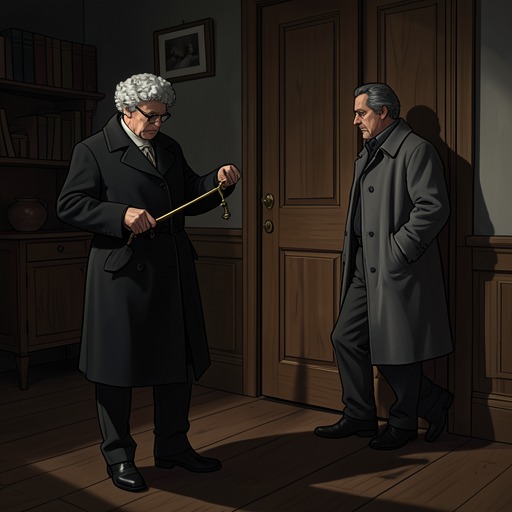
Poirot’s little grey cells
The Mysterious Affair at StylesPoirot’s little grey cells name the disciplined private reasoning by which Hercule Poirot turns scattered clues into a causal account of Emily Inglethorp’s death. Their importance is clearest when outside leads prove insufficient: instead of accepting a conspicuous accusation or an assumed method of poisoning, Poirot tests what the evidence actually permits and follows the chain to its final link.
Meaning and Method
Poirot invokes his little grey cells after a letter he had hoped would help the investigation fails to provide the answer. He says the affair must be unravelled from within, taps his forehead, and describes the work as being up to his little grey cells. The moment makes the phrase a practical account of his method: when a document cannot settle the case, he must reason from the facts already available.
That reasoning proceeds by checking assumptions rather than treating them as conclusions. The initial contention is that Emily died of strychnine poisoning, presumably administered in her coffee. Poirot’s question about when the coffee was served turns attention from the mere presence of poison toward the timing and circumstances of its administration. The distinction matters: identifying a poison does not, by itself, establish how or when it entered the victim’s body.
Testing the Apparent Case
Poirot also subjects the case against Alfred Inglethorp to competing explanations. Alfred’s stated excuse for being away from the house seems contrived, but Poirot argues that this fact alone does not settle guilt. If Alfred knew that Emily would be poisoned that night, he would have had reason to arrange to be absent; alternatively, he might have had some other reason for his absence. The outwardly suspicious detail therefore opens a question rather than closing one.
The evidence against Alfred becomes more troubling precisely because it appears too complete. Poirot contrasts genuine evidence, which is often vague and unsatisfactory and must be sifted, with a case that seems cut and dried. He concludes that it has been cleverly manufactured and that its excessive precision defeats its purpose: while vague evidence would be difficult to disprove, evidence drawn too tightly can be severed by a single contradiction. His method thus includes recognizing when a strong-looking case is itself an object requiring explanation.
Reconstructing the Poisoning
The decisive reconstruction changes the assumed medium. Poirot identifies a damp carpet stain with the odor of coffee and small fragments of china embedded in it. He connects those traces to a cup that had fallen from a tilting table, and infers that Emily’s coffee was spilled rather than drunk. The cocoa she subsequently heated and drank contained no strychnine, so neither drink accounts for the poison that took effect.
Poirot then identifies Emily’s medicine as the missing medium. His account is that the strychnine was already present in the prescribed mixture, rather than introduced into it at the moment of poisoning. The inference explains how the poison could have been taken even though the coffee remained undrunk, and it shifts the inquiry from a conspicuous beverage to the medicine’s role in the chain of events.
Timing supplies the final connection. The tragedy had apparently been intended for Monday evening: Emily’s bell wire had been cut, and Cynthia was spending the night with friends, leaving Emily isolated in the right wing. But Emily forgot to take her medicine while hurrying to a village entertainment, then lunched away from home the next day. The fatal dose was consequently taken twenty-four hours later than anticipated. Poirot says that this delay gave him the last link of the chain.
Evidence and Limits
The inward reconstruction is ultimately joined to physical evidence outside Poirot’s reasoning. He produces three thin strips of paper and identifies them as a letter in the murderer’s handwriting, then pieces them together and reads the recovered message. The letter’s existence strengthens the case by connecting the reconstructed mechanism to the person responsible; Poirot’s explanation does not rest on intuition alone.
The phrase therefore represents neither a mysterious faculty nor a substitute for proof. Poirot uses it for the work of comparing explanations, testing the apparent significance of clues, and tracing consequences through time. The spilled coffee, the unpoisoned cocoa, the medicine, the missed dose, and the delayed fatal dose become meaningful in relation to one another. His little grey cells are the method that makes those separate details form a coherent account, while the recovered letter supplies an evidentiary link beyond deduction.